

光学薄膜の設計・解析・最適化を強力に支援
TFCalc は、絶縁体や金属を形成する光学薄膜コーティングの特性を計算します。特性には、反射率、透過率、吸収性、位相ずれ、電界 (電場)、色が含まれます。TFCalc は 5000 レイヤーまでのコーティングを取り扱うことができます。これにより、特殊な用途に見合ったコーティングのデザインを最適化することができます。また、TFCalc には光学的な定数のデータベースが含まれます。一旦、コーティングがデザインされると、そのパフォーマンスが入射角や波長の幅を使用して解析されます。また与えられた波長での電界強度を計算します。その優れた計算精度と解析力から、学術機関や企業の多様な研究論文・学会発表でも幅広く活用されています。 日本語 PDF マニュアルも付いてさらに使いやすくなりました。
TFCalc イントロダクション動画では、透過率・反射率のシミュレーションに加え、ターゲット設定から最適な膜構成を自動算出する「最適化機能」の基本操作を解説しています。机上の空論に終わらせないための製造誤差評価 (感度解析) 機能も含まれています。実務に即したコーティング設計を支える TFCalc の概要をご覧ください。
作業の流れ
下のフローダイアグラムは、薄膜コーティングのデザインにおける TFCalc プログラムの使い方を示しています。設計作業の概略をこのダイアグラムで確かめてください。
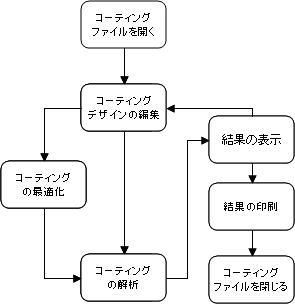
このプロセスは、新規あるいは既存のコーティングファイル (File メニューの New か Open を選択) を開くことにより始まります。次に、コーティングのデザインを変更します (Modify メニューから選択)。さらに、コーティングの最適化や解析を行います (Run メニューから選択)。このとき、結果を確認することができます(Results メニューから選択)。デザイナーは結果を印刷することができます (結果がスクリーンに表示されているときに Options メニューから選択)。最後にコーティングデザインを保存します (File メニューから Save を選択したあと Close を選択)。
これは1つのシナリオにすぎませんが、プログラムの使い方がお分かりだとおもいます。デザイナーは短時間でプログラムを使えるようになり、操作に煩わされることなくデザインに集中できます。
モデル
次のダイアグラムは TFCalc における物理的なシステムの説明です。
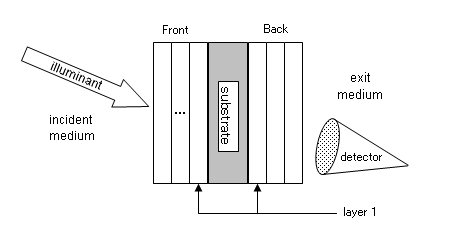
データベースに格納されている光源は (illuminant)、スペクトル強度対波長のテーブルとして与えられます。入射角は 0 から 89.999 度の範囲です。基板および入射媒質と射出媒質は Substrate データベースから選択されます。効率対波長のテーブルとして与えられる検知器 (detector) は Detector データベースから選択されます。非常に厚いレイヤーとして基板の厚さも指定できます。また、基板が空気ということもありえることに注意してください。
たとえば、基板と射出媒質双方とも吸収物質かもしれません。フロントとバックレイヤーを構成する物質は Materials データベース (または Variable Materials ウィンドウから) 選択されます。現在、レイヤーの数は 5000 に制限されています。基板と物質の光学特性は、テーブルまたは複素屈折率の分散式 (n-ik) 対波長として格納されています。
フロントとバックのどちらの面に光がまず当たるかを指定できるようになりました。すなわち、コーティングのどちらの面からも光を当てることができます。詳細は Environment ダイアログを参照ください。
レイヤー1 が基板に隣接することに注意してください。
| 注: もし基板と射出媒質が異なるなら (あるいはバックレイヤーがあるなら)、基板の背面による反射が計算されます。これを避けるには、射出媒質が基板と同じでバックレイヤーがないようにする必要があります。 |
複数の薄膜レイヤーコーティングの解析と設計
- 反射率、透過率、吸収率、光学濃度、損失、色、輝度、psi、反射または透過における位相シフト、電場強度の計算とプロットが実行できます。
- 製造誤差に対するコーティングの感度 (sensitivity) が解析できます。感度を最小にするために最適化を使うことができます。レイヤーの感度を計算し表示できます。

- 円錐角 (光の収束ビームとして) とユーザー定義放射分布のコーティングを解析できます。
- コーティング物質、基板、射出媒質が光を分散および吸収し、入射媒質が分散する場合があります。物質と基板のインデックスを得るために分散式が使用できます。
- 基板あるいはレイヤーの反射率 (n とk) は測定データから決定できます。
- 光源を指定できます。薄膜の反射や透過が光源として格納されるので、一つのフィルターのアウトプットを他のフィルターのインプットにすることができます。また、黒体光源の作成も可能です。
- 検知器の機能を指定できます。
- 基板の厚さが有限なので、反射と透過の計算は基板の背面と基板内の減衰を考慮します。
- 150 の異なる物質からなる 5000 レイヤーまでのコーティングか可能です。
- H(LH)^5 のような式を使ってレイヤーの “スタック” を入力できます。
- レイヤーをグループに分け、グループを最適化できます。
- レイヤーのインデックス (n と k) および厚さを最適化できます。
- 基板の両側のレイヤーを同時に最適化できます。同期化のあいだ、レイヤーの厚さは最大値と最小値の間に拘束できます。
- 単なる局所最小 (Local minimum) ではなく、最良のコーティング設計を見つけるために、大域探索 (Grobal search) が使用できます。
- 5000 までの最適化ターゲットを指定できます。また、ターゲットは <10% や >90% のような不等式でもかまいません。
- たとえば、複数の基板のコーティングを創り出すために、複数の環境が使用できます。
- ニードル最適化は、デザインにレイヤーを自動的に追加できます。もしデザインの要求が一般的でないなら、これは非常に有効です。連続した最良のデザインを自動的に作成するために、トンネル法が使用できます。
- ターゲットを自動的に作成できます。また、ターゲットをファイルより読み出すことも可能です。色と輝度のターゲットが作成できます。
- 一次、二次、三次導関数 (波長または波数に関する) をターゲットとして使用できます。
- 等価インデックス (equivalent index) を計算できます。またレイヤーを、レイヤーのインデックスにマッチする等価 (HLH)^p または (LHL)^p スタックで置き換えることも可能です。
- 勾配法 (Gradient)、可変計量法 (Variable Metric)、シンプレックス法 (Simplex) という3つの局所最適化法が使用できます。
- 物質、基板、光源、検知器、分布に関する無数のデータが入力できます。
- 6つの薄膜計算の結果を、同じグラフ上にプロットすることにより比較できます。たとえば、反射と透過のような異なるタイプのプロットを重ねることが可能です。
- パラメータの最小値、最大値、平均値を波長の範囲で計算できます。
- 光学的なモニター曲線を計算しプロットできます。
- 他のソフトウェアのために、結果をテキストファイルで保存できます。
コーティングデザイン
ここではコーティングデザインをご紹介します。これらのコーティングは、デザインに関する問題の完全な答えではなく、また、初めての発表というものでもありません。むしろ、将来有望なデザインを生み出すために、どのように TFCalc を利用するかを説明しているものとご理解ください。
反射防止
レフレクター
その他
開発元:株式会社ヒューリンクス
機能一覧
TFCalc は、多くの特徴を持った強力なプログラムです。ここで紹介するのは要約であって、すべてを網羅したものではありません。
薄膜
- 基板の前面、背面に最大5000 レイヤーを設定可能
- (HL)^5 1.2(HL)^5 のようなスタック形式で、レイヤーを追加可能

- 可変な屈折率を持つレイヤーを設定可能
- レイヤーは物理あるいは1/4波長光学膜厚のどちらでも入力可能
- 角度に対して各レイヤーの膜厚が調整可能
- レイヤーは、等価な (HLH)^p または (LHL)^p スタックにおきかえることが可能
- レイヤーは対称性を維持、あるいは順番をシフトするためにグループ化することが可能
- ルゲートコーティングのシミュレート
解析
- 反射率、透過率、吸収率、光学濃度、損失、位相差、psi、電場強度の計算
- 反射および透過色の計算 (CIE および LAB)
- 等価 (Herpin) 屈折率の計算
- 製造誤差 (膜厚、屈折率) に対する反射率、透過率、吸収率、光学濃度、損失、位相差、色の感度の計算
- ユーザー定義の輻射分布の円錐角平均 (バイコニカル) 反射率、透過率、吸収率、濃度、損失を計算
- Muller または Abeles 位相差コンベンションが選択可能
- 光モニターの出力がシミュレート可能
最適化
- 3手法に対応:可変計量法、勾配法、シンプレックス法
- 最良のコーティング設計を探索できるグローバルサーチ
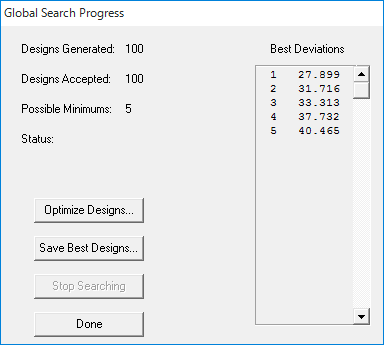
- 特殊な設計のためのニードル最適化 (トンネリング最適化)
- 膜厚と屈折率のどちらか、および両方を最適化可能
- 最適化中、偏差の表示が可能
- 最適化中、屈折率のプロファイルを表示可能
- フレキシブルなメリット関数
- 前面、背面のレイヤーを同時に最適化
- グループ因子を最適化
- 感度も最適化可能
- 最適化中、膜厚がゼロのレイヤー自動的に削除可能
- 特定の環境に適したコーティングを最適化するために、発光·受光機能を入力が可能
- R*T の積を最適化
最適化対象
- 最適化対象はすべての波長、偏光、角度における反射率、透過率、吸収率、濃度、色、照度、位相差、psi
- 最適化対象は離散 (1つの波長) でも連続 (波長の範囲) でも可能
- 1次、2次、3次導関数が対象に設定可能
- 最適化対象は手動、自動生成、ファイルから読み込むことも可能
- 最適化対象は不等号も設定可能
- 最大 5000 対象をサポート
結果
- 結果は数値およびグラフで表示
- 全データおよびグラフの印刷可能
- 新たに解析を始める場合、それまでの結果をファイルに保存可能
- 最大 5 コーティングの結果を1つのグラフに同時に表示可能
- 反射率と透過率のように2つの結果を1つのグラフに表現可能
- 統計的な解析も可能
光学的データ
- 基板、発光、受光、輻射分布データファイル数の制限はなし
- 屈折率は表あるいは分散式で入力可能
- 基板の内部透過率の読み込み可能
- N または K の欠損値は補完可能
- 屈折率 (N、K) はスベクトルまたはエリプソメトリーデータから計算
- マテリアルと基板データは吸収および分散の設定が可能
- コーティングの反射率または透過率は、発光データとして保存可能
- データファイルに注釈を付けて保存可能
- テキストファイルのデータを読み込み可能
- 黒体の発光を生成可能
コーティングファイル
- レイヤー、最適化対象、注釈、マテリアルなどコーティングに関するすべての情報を含む
- コーティングファイルは容易にコピー可能
精度
- 全ての計算は16桁浮動小数点演算で実行
- 最適化中、最大 500,000 レイヤー/秒で計算可能
ユーザーインターフェイス
- 使いやすい Win 標準インターフェイスを採用
- メニュー、ダイアログはスプレッドシート風のウィンドウ
- 編集や再計算も容易
※ 各バージョンのアップデート情報はこちら
TFCalc はさまざまな論文で活用されています!
| Design and experimental evaluation of TiO2/MgF2 dual-layer anti-reflection coatings for Nd- and Er-doped phosphate glass lasers |
|---|
| Le Van Dai 1, Do Thanh Tung 2, Pham Duc Tuan 1, Truong Hong Giang 1 1 Academy of Military Science and Technology, 17 Hoang Sam, Nghia Do, Hanoi, Vietnam 2 Institute of Technical Physics, 17 Hoang Sam, Nghia Do, Hanoi, Vietnam |
| DOI: https://doi.org/10.15625/0868-3166/22927 |
| (Abstract) This study focuses on the design and experimental evaluation of two-layer TiO2-MgF2 anti-reflection (AR) coatings on Nd- and Er-doped phosphate glass for laser applications at 1053 nm and 1535 nm. Using matrix theory and TFCalc software, the optimized design achieves reflectance close to 0% for Nd-doped glass and below 0.1% for Er-doped glass. The coatings were fabricated using the SYRUSpro 710 system, achieving experimental transmittance values of 99.7% in the 1050–1080 nm range and 99.8% in the 1530–1570 nm range, despite minor discrepancies between experimental and simulated results. The coating durability meets MIL-SPEC standards for mechanical testing. Additionally, laser-induced damage threshold (LIDT) measurements at 1064 nm yielded a 50% damage fluence of 13.2 J/cm² for the Nd-doped sample, demonstrating reliable laser resistance suitable for moderate-fluence solid-state laser applications. This research lays the foundation for optimizing coating processes and advancing the development of rare-earth-doped solid-state laser sources. |
| Anti-Reflective Coatings Produced via Atomic Layer Deposition for Hybrid Polymer 3D Micro-Optics |
|---|
| Darija Astrauskytė 1, Karolis Galvanauskas 2, Darius Gailevičius 2, Mantas Drazdys 1, Mangirdas Malinauskas 2,* and Lina Grineviciute 1,* 1 Center for Physical Sciences and Technology, Savanorių av. 231, LT-02300 Vilnius, Lithuania 2 Laser Research Center, Physics Faculty, Vilnius University, Saulėtekio av. 10, LT-10223 Vilnius, Lithuania * Authors to whom correspondence should be addressed. |
| Nanomaterials 2023, 13(16), 2281; https://doi.org/10.3390/nano13162281 |
| (Abstract) The increasing demand for optics quality requires the lowest optical power loss, which can occur from unwanted reflections. Laser direct writing (LDW) allows for the fabrication of complex structures, which is particularly advantageous in micro-optic applications. This research demonstrates the possibility of forming an anti-reflective coating on hybrid polymer micro-lenses fabricated by employing LDW without changing their geometry. Such coating deposited via atomic layer deposition (ALD) decreased the reflection from 3.3% to 0.1% at a wavelength of 633 nm for one surface of hybrid organic–inorganic SZ2080™ material. This research validates the compatibility of ALD with LDW 3D multiphoton lithography synergistically, expanding its applications on optical grade sub-100 μm scale micro-optics. |
| Polarization modeling and predictions for Daniel K. Inouye Solar Telescope part 5: impacts of enhanced mirror and dichroic coatings on system polarization calibration |
|---|
| David M. Harrington 1, Stacey R. Sueoka 1, Amanda J. White 1 1 National Solar Observatory (United States) |
| Journal of Astronomical Telescopes, Instruments, and Systems, Vol. 5, Issue 3, 038001 (Jun 2019) https://doi.org/10.1117/1.JATIS.5.3.038001 |
| (Abstract) The Daniel K. Inouye Solar Telescope (DKIST) is designed to deliver accurate spectropolarimetric calibrations across a wide wavelength range and large field of view for solar disk, limb, and coronal observations. DKIST instruments deliver spectral resolving powers of up to 300,000 in multiple cameras of multiple instruments sampling nanometer scale bandpasses. We require detailed knowledge of optical coatings on all optics to ensure that we can predict and calibrate the polarization behavior of the system. Optical coatings can be metals protected by many dielectric layers or several-micron-thick dichroics. Strong spectral gradients up to 60 deg retardance per nanometer wavelength and several percent diattenuation per nanometer wavelength are observed in such coatings. Often, optical coatings are not specified with spectral gradient targets for polarimetry in combination with both average- and spectral threshold-type specifications. DKIST has a suite of interchangeable dichroic beam splitters using up to 96 layers. We apply the Berreman formalism in open-source Python scripts to derive coating polarization behavior. We present high spectral resolution examples on dichroics where transmission can drop 10% with associated polarization changes over a 1-nm spectral bandpass in both mirrors and dichroics. We worked with a vendor to design dichroic coatings with relatively benign polarization properties that pass spectral gradient requirements and polarization requirements in addition to reflectivity. We now have the ability to fit multilayer coating designs which allow us to predict system-level polarization properties of mirrors, antireflection coatings, and dichroics at arbitrary incidence angles, high spectral resolving power, and on curved surfaces through optical modeling software packages. Performance predictions for polarization at large astronomical telescopes require significant metrology efforts on individual optical components combined with system-level modeling efforts. We show our custom-built laboratory spectropolarimeter and metrology efforts on protected metal mirrors, antireflection coatings, and dichroic mirror samples. |
動作環境
TFCalc Windows 版 (version 3.6.2)
- Windows 10, 11
64-bit 環境では 32-bit モードで動作します。
アプリケーションは英語版。日本語 PDF マニュアルが付きます。
ライセンス
TFCalc は、シングルユーザーライセンス もしくは シングルマシンライセンス です。シンクライアント環境で使用する場合はお問い合わせください。
シングルユーザーライセンス
- 同一ユーザーが利用する場合に限り、2台までインストールすることが可能です (※同時利用不可) 。
- 複数ユーザーで使用する場合には、ユーザー数分のライセンスをご購入ください。
シングルマシンライセンス
- TFCalc を1台のマシンのみにインストールする場合、複数ユーザーでのご利用が可能です。
- 複数台にインストールしたい場合、台数分のライセンスをご購入ください
※ 使用許諾契約書はこちら
トライアル
デモ版お申込み
製品価格
※ 製品価格は、見積依頼フォームよりお問合せください。
お見積り・ご購入
サポート
インストール手順 [3.5.16 以降]
TFCalc 3.5.16 (2023 年 1 月リリース) より、USB キーではなくソフトウェアアクティベーションキーに変更されています。マシン変更に伴うソフトウェアアクティベーションキーの再発行は 2 回まで無償です。 3 回目以降はライセンスファイル再発行費用が必要です。
インストール手順 [~3.5.15]
旧バージョンのハードウェアキーを破損した場合は、再発行はできません。ソフトウェアキーの TFCalc 3.6 へのアップグレードが必要です。
サポートお問い合わせ
TFCalc チュートリアル
単層の反射防止膜
2層 (V、Wコーティング)
Global Search (V、Wコーティング)
ビームスプリッターの設計
光学膜厚モニタリングのシミュレーション
多層薄膜設計の最適化
ニードル法を用いた最適化
導入事例
光学システム技術プログラムにおけるTFCalc の活用

Monroe Community College では、薄膜設計とコーティング技術に焦点を当てた実践的な実験科目で TFCalc を使用し、学生を即戦力となる技術者に育成しています。(2026/4/17)