
Thin Film Coating Examples
TFCalc is capable of designing multilayer coatings for many applications. To aid the designer, 36 sample designs are included with TFCalc.
Anti-Reflection Filters
Also called AR coatings. Probably the most common type of coating, an anti-reflection coating reduces the reflection (increases the transmission) of the surface on which it is applied. AR coatings may be designed for any part of the spectrum. It is possible to create high efficiency AR coatings (which reduce the reflectance very close to zero for a narrow band of wavelengths), broadband AR coatings, multiband AR coatings, etc.
The graphic below shows the performance of a 4-layer design that reduces the reflectance of glass from its usual value of about 4% down to less than 0.1%.
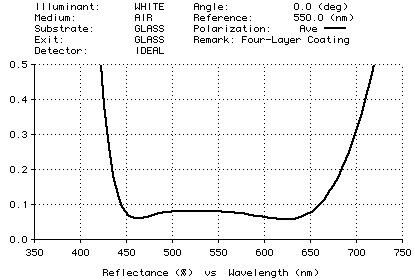
Here is another example of an AR coating:
Bandpass Filters
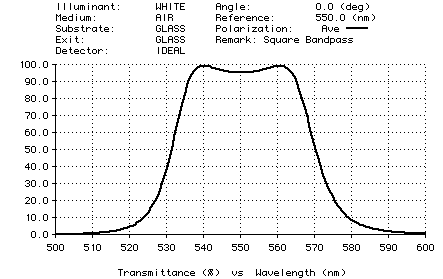
This type of filter transmits a band of wavelengths (the passband) and rejects wavelengths outside of that band. The passband can be narrow or wide. The transition from transmitting to rejection can be gradual or sharp. Filters having multiple passbands are also possible.
The graphic below shows a fairly narrow bandpass filter.
Here are more examples of bandpass filters:
- How to create a Wide Infrared Bandpass Filter
- A narrow Metal-Dielectric Bandpass Filter
- Narrow Metal-Dielectric Dual Bandpass Filter
- Family of WDM and DWDM Filters
Beamsplitters
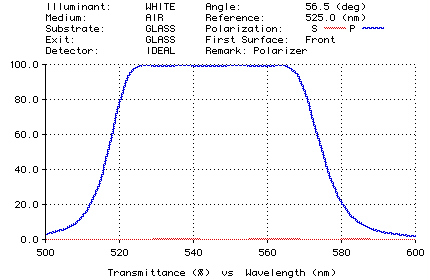
A great variety of coatings fall into the “beam splitter” category. In general, whenever both the reflected and transmitted light are controlled, the coating is called a beamsplitter. Quite often, the coating must operate at angles other than normal incidence. The design is more difficult when the polarization of the reflected and/or transmitted light must be controlled. Even more difficult are designs that seek to control the phase change of the reflected or transmitted light. Another factor is the width of the spectrum over which the coating is to operate.
The graphic below shows the performance of a 40-layer polarizing beamsplitter which performs quite well from 525 to 565 nm. Note that the S polarization is very close to zero in the entire 500-600 nm region. This non-traditional design was created with the needle optimization method.
Edge Filters
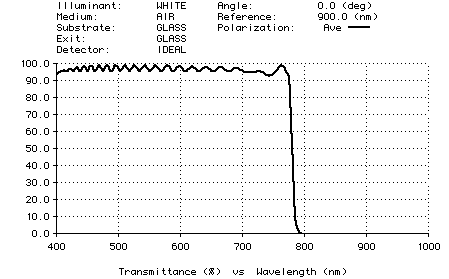
There are two types of edge filters: Long Wave Pass and Short Wave Pass. In the long wave pass filter, the goal is to minimize transmission below a given wavelength and maximize transmission above it. These designs are usually based on a quarter-wave stack (HL)^p, which has a well-defined transition from reflecting to transmitting. Sometimes absorbing materials are used to increase the optical density of the non-reflecting (rejection) band of the filter. In the short wave pass filter, the goal is to minimize transmission above a given wavelength and maximize transmission below it.
The graphic below shows the performance of a 37-layer short wave pass filter.
Notch (or Minus) Filters
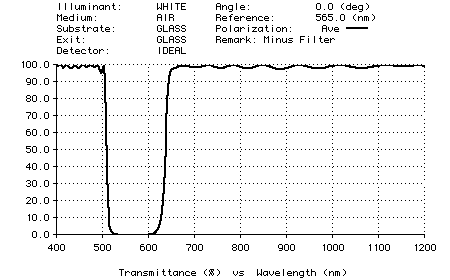
A notch, or minus, filter requires that the transmittance be minimized in a rejection band and maximized outside of that band. The rejection band is usually narrow. This type of filter is one of the most difficult to design.
The graphic below shows the performance of a 34-layer notch filter.
Phase Retarders
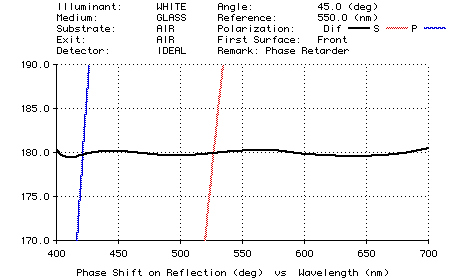
Phase retarders are used to control the phase of reflected or transmitted light.
The graphic below shows the performance of a 180-degree phase retarder using total internal reflection to reflect 100% of the beam. It is assumed that the mirror is coated on the hypotenuse of a right prism, so that the incident medium is glass and the exit medium is air. Note: The Abeles phase convention is used.
Reflectors
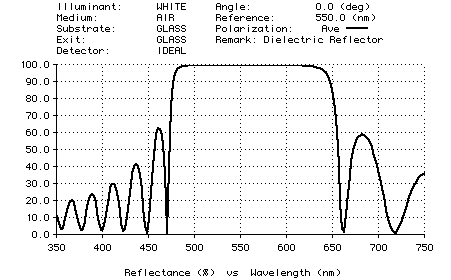
The purpose of these coatings is to reflect light. Again, depending on the requirements, there are quite a variety of possible designs. Designs based on metal layers are used in many applications. However, the reflectance is not very close to 100% and the coating will be damaged by intense radiation. For very high reflectance, dielectric materials must be used. To obtain wide-band reflectors, designs for different wavelength regions may be coated on top of each other.
The graphic below shows the performance of a 19-layer H(LH)^9 dielectric reflector.
Here are more examples of reflectors:
Color Correction
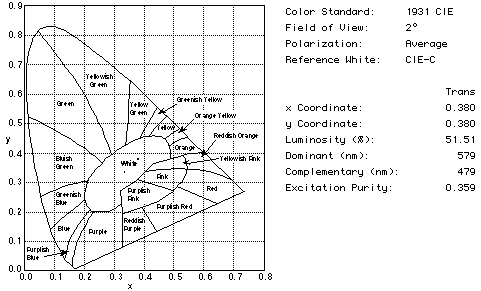
TFCalc can design coatings that control the color of transmitted or reflected light. For example, the graphic below shows how a 2800K source was corrected to transmit light having an (x,y) color of (0.38,0.38). The coating consists of 6 layers of SiO2 and TiO2.
Color filters of virtually any color can be designed.
Using TFCalc 3.4 or later, it is even possible to control the color of light reflected by both sides of a coating. For example, the color of reflected light could be blue on one side and red on the other side.
Fabry-Perot Filters
This type of filter transmits a narrow band of wavelengths and rejects wavelengths outside of that band. An interesting feature of this type of filter is its ability to “select” a different peak wavelength as the filter is tilted.