
List of coating design exapmles
New Thin Film Polarizing Beamsplitter
In the paper*,
Li Li and J.A. Dobrowolski, “New developments in thin film polarizing beamsplitters”, in Optical Interference Coatings, Vol. 9, OSA Technical Digest Series, (Optical Society of America, Washington DC, 1998), pp. 158-160.
given at the Optical Interference Coatings conference in June 1998, the authors discuss a new design for a high-performance polarizing beamsplitter based on frustrated total internal reflection. This polarizer has the following advantages: non-absorbing, broad band, wide-angle, and high extinction ratios (Ts/Tp and Rp/Rs). The diagram below illustrates the operation of this polarizer.
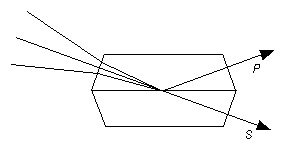
The coating is sandwiched between two prisms. Note that S polarized light is transmitted, which is the opposite of other designs. Also, note that light strikes the coating at a very high angle.
Although the authors do not give the exact details of the coating design, it is possible to use TFCalc to create such a polarizer. Here we design a polarizer for 400-700 nm to operate for the angles 65-75 degrees in the prism. This design requires a high-index glass prism. An index of 1.85 is used in this design. This means that the range of angles in air is ア9.28, which is considered wide-angle. We use the following 22 continuous optimization targets:
- S Transmittance > 99.9% for wavelengths 400-700 nm at angles 65,66,…,75
- P Optical Density > 3.0 for wavelengths 400-700 nm at angles 65,66,…,75
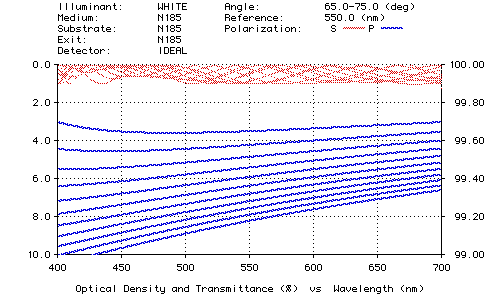
There are many ways to design this coating. One simple method is to start with a stack such as (0.5H L 0.5H)^n that reflects the P polarization for the wavelengths and angles given above, and then use optimization to force the coating to transmit S polarization. Here H and L represent quarter-wave layers of index 2.35 and 1.45, respectively. Some tests show that if we start with the 21-layer design created by setting n=10, then the optimization targets given above will be met. The performance is shown below, with the left scale for the optical density of P reflectance and the right scale for S transmittance. The extinction ratio is greater than 1000 for all design angles and wavelengths.
Here is the design, with the first layer closest to the substrate and thickness given in nm:
    H     11.16
    L     48.87
    H     35.94
    L     68.58
    H     39.50
    L     79.77
    H     46.20
    L     96.61
    H     49.71
    L    102.74
    H     50.49
    L    102.74
    H     49.71
    L     96.61
    H     46.20
    L     79.77
    H     39.50
    L     68.58
    H     35.94
    L     48.87
    H     11.16
Note, curiously, that optimization preserved the symmetry of the original design (i.e., layers 1 and 21, 2 and 20, 3 and 19, etc., have the same thickness).
The authors are commended for this ingenious polarizer, which is the subject of a patent application. However, it seems that this polarizer has two drawbacks: (1) the dimensions of the prisms may prevent its use in some applications and (2) the prisms seem to require a high-index glass, which presents other problems.
*Recently, a paper was published that gives much more detail about this polarizer. See
- Li Li and J.A. Dobrowolski, “High-performance thin-film polarizing beam splitter operating at angles greater than the critical angle”, Applied Optics, Vol. 39, No. 16, pp. 2754-71.