
List of coating design exapmles
Broadband High-Reflection Coating at 50 Degrees
In the paper,
Konstantin V. Popov, J.A. Dobrowolski, Alexander V. Tikhonravov, and Brian T. Sullivan, “Broadband high-reflection multilayer coatings at oblique angles of incidence,” Applied Optics, Vol. 36, No. 10, 1 April 1997, pp. 2139-2151
The authors examine the problem of creating broadband dielectric reflectors using contiguous quarter-wave stacks. It is an interesting paper — well worth reading if you need to design this type of coating. The following example is taken from the paper.
The goal is to design a high reflector which operates in the wavelength range 400-800 nm at a 50 degree angle of incidence. Because this coating is at 50 degrees, the reflectance of S polarization will be much higher than P. Hence, we can concentrate on controlling the reflectance for P polarization. The coating, composed of layers of L (index 1.45) and H (index 2.35), is to be deposited on glass G (index 1.52). The incident medium is air (index 1.0).
The formulas in the paper lead to a 3-stack (7 periods/stack) design whose stacks are centered at wavelengths 705, 555, and 437 nm. To increase the reflectance, the authors add one additional H layer next to the substrate. The result is a 43-layer coating whose average P reflectance is 98%.
TFCalc can be used to design and refine this type of coating. The starting design is a 43-layer coating with the stack formula
G a(HL)^7 b(H(LH)^7) c(LH)^7 air
where H and L represent 1 QWOT (quarter-wave optical thickness) at a reference wavelength of 550 nm and incident angle of 50 degrees, and the factors a, b,and c must be determined using “group” optimization. (This is called group optimization because we vary the thickness of a group of layers; all layers in the same group keep the same relative thickness to the other layer in the group.) Using one continuous target (Rp=100% for 400-800 nm at 50 degrees) and starting values of
a = 1.2000, b = 1.0000, c = 0.8000,
group optimization finds
a = 1.3260, b = 1.0171, c = 0.7855.
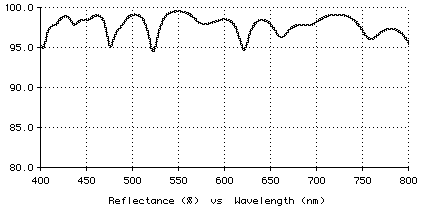
These values correspond to stacks centered at 729, 559, and 432 nm. The average P reflectance is about 98%. The performance for P polarization is displayed below.
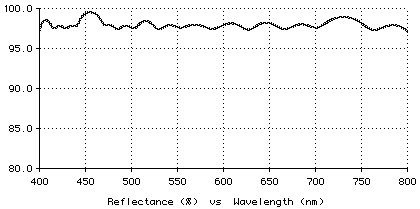
If all layers are optimized to improve the reflectance, the average P reflectance stays approximately the same; however, the minimum reflectance is substantially higher, as shown below.
Here is the last design, with the first layer closest to the substrate and thickness given in nm.
    H      97.87
    L     171.35
    H      80.56
    L     152.15
    H      74.35
    L     154.04
    H      83.10
    L     178.45
    H      72.02
    L     129.75
    H      85.36
    L     141.64
    H      82.96
    L     141.89
    H      71.17
    L     137.71
    H      69.96
    L     104.04
    H      55.42
    L     113.89
    H      71.53
    L     121.61
    H      63.21
    L     111.11
    H      61.47
    L     121.69
    H      63.51
    L     101.69
    H      56.86
    L     101.16
    H      52.26
    L      82.60
    H      46.62
    L      94.22
    H      53.49
    L      90.92
    H      46.16
    L      86.62
    H      51.59
    L      91.80
    H      45.96
    L      80.64
    H      49.35